

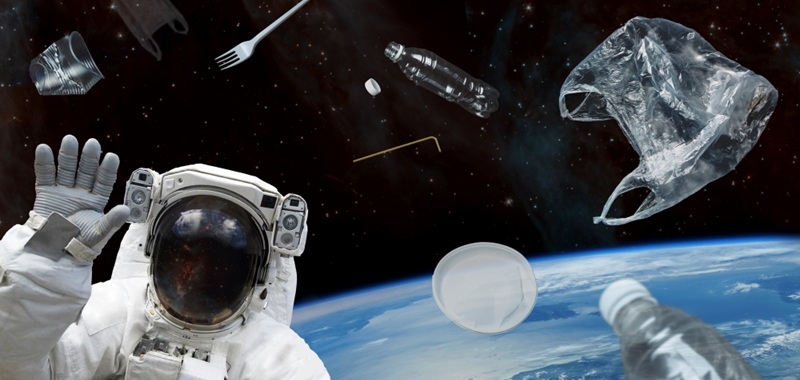
Earth's orbit is no longer empty. Thousands of working satellites circle the planet, but they are not alone. Alongside them is a growing cloud of inactive hardware, fragments, and microscopic particles. This is known as space debris.
Space activity is increasing every year. Communication networks, GPS navigation, weather monitoring, and television all depend on satellites. Because of that growth, the problem has moved from theoretical to operational. Engineers now plan missions around avoiding collisions.
This article explains the problem clearly, what causes it, and how agencies try to control it.
Sources referenced include NASA orbital debris documentation and the Natural History Museum research on orbital pollution.
What is the space debris? It is any human made object in orbit that no longer performs a useful function.
According to NASA, orbital debris includes defunct satellites, rocket stages, and fragments created by explosions or collisions. The Natural History Museum refers to the same material as space-junk left behind after missions end.
Large objects
Medium objects
Tiny particles
Even a 1 centimeter piece can damage a spacecraft because orbital speeds exceed 7 kilometers per second. At that velocity, a small particle carries massive kinetic energy.
Top pick: Astrophotography Targets for Each Season of the Year
Low Earth orbit is the busiest region around Earth. It is used by imaging satellites, research stations, and internet constellations.
Why companies prefer this orbit
The problem is accumulation. Objects do not disappear quickly. Some remain for decades.
NASA tracking networks monitor hundreds of thousands of objects and estimate millions of smaller fragments exist but cannot all be tracked.
The danger is not the size. It is the speed.
A bolt in orbit moves faster than a rifle bullet. Impact energy multiplies dramatically with velocity. Spacecraft shielding protects against small particles, but larger fragments can destroy a satellite instantly.
A major collision can also create thousands of new fragments, increasing future risk.
Scientists describe a cascading scenario where collisions create more collisions. When debris density rises above a threshold, every impact produces fragments that hit other spacecraft.
This scenario is often called a debris cascade. It could make some orbital altitudes unsafe for decades.
That is why preventing new debris matters more than cleaning existing debris.
What is debris mitigation? It is the set of rules and engineering practices designed to prevent creation of new orbital debris.
NASA and international space agencies require mission planners to include disposal strategies before launch approval.
Avoid explosions
Prevent collisions
End of life disposal
Design improvements
The idea is simple. Do not add new material to orbit.
Satellites cannot stay in orbit forever. They must be removed after their mission ends.
Two main options exist.
Both methods are part of debris mitigation standards.
Ground radar and optical telescopes constantly track debris.
Operators receive alerts when a close approach is predicted. They can then adjust altitude or timing.
Air traffic control manages airplanes in the atmosphere. Orbital tracking performs a similar function for satellites.
Without tracking, launches would be extremely risky.
Also check: Mars Exploration Rovers: Pioneers of the Red Planet
Prevention alone cannot solve the existing problem. Old debris remains in orbit.
Engineers are testing removal techniques.
Current research concepts
Large abandoned satellites are the main targets because removing a few heavy objects significantly reduces collision probability.
Cleaning space sounds simple but several factors complicate it.
Because of this, debris mitigation is prioritized over cleanup.
People rarely notice satellites, but daily life depends on them.
Services at risk
If collision damage disables enough satellites, these systems degrade or fail.
Space debris therefore affects life on Earth, not only astronauts.
Mega satellite constellations are expanding rapidly. Thousands of new spacecraft are planned.
Benefits
Risks
Future space operations will depend heavily on strict debris mitigation compliance.
More to Discover: Exploring the Mysteries of Jupiter Great Red Spot & Storm
Earth orbit has become an operational environment rather than an empty frontier. Satellites support essential global systems, but their long-term reliability depends on controlling orbital clutter.
The solution is not one technology. It is disciplined behavior. Every mission must include safe disposal and collision prevention planning. Without consistent debris mitigation, access to space becomes progressively harder.
Space exploration now requires environmental responsibility beyond Earth.
Quick answers to common questions.
It is an inactive human-made material in orbit, including dead satellites and fragments from collisions.
It refers to engineering and operational practices used to prevent new debris and safely dispose of spacecraft.
Most fragments are too small to see. Occasionally, larger objects burn in the atmosphere and appear as brief streaks of light.
This content was created by AI